 Pb28
Pb28 Free Online Developer Tools
Technical Audit Report: Architecture, Search Optimization, and AdSense Engineering of the MultiUtility.info Directory
System Type: PHP Registry-Driven Static Template Engine
Audit Context: Source Code Distribution Asset Analysis
Document Classification: Technical Whitepaper / Operational Documentation
1. Executive Summary
The directory interface at /developer-tools serves as the centralized hub for the entire application ecosystem of MultiUtility.info. It consolidates and indexes a diverse array of browser-based utilities across multiple disciplines, including minifiers, string formatters, encoders, cryptographic hash generators, and network calculators.
From an architectural standpoint, this page functions as a critical optimization layer. It balances highly responsive client-side JavaScript searching with server-rendered HTML blocks designed to meet search engine indexation requirements and clear Google AdSense compliance gates. This report provides a structural, performance, and monetization review of the primary tools directory component.
2. Code Architecture & Component Evaluation
The workspace relies on a split compilation strategy that maximizes delivery speed while ensuring content discoverability.
2.1 The Unified Tool Registry System
The page initializes by calling the global tools registry (includes/tools-registry.php), which aggregates standalone arrays from modular configuration files under the /includes/registry/ directory. 2.2 Server-Side Grid Rendering
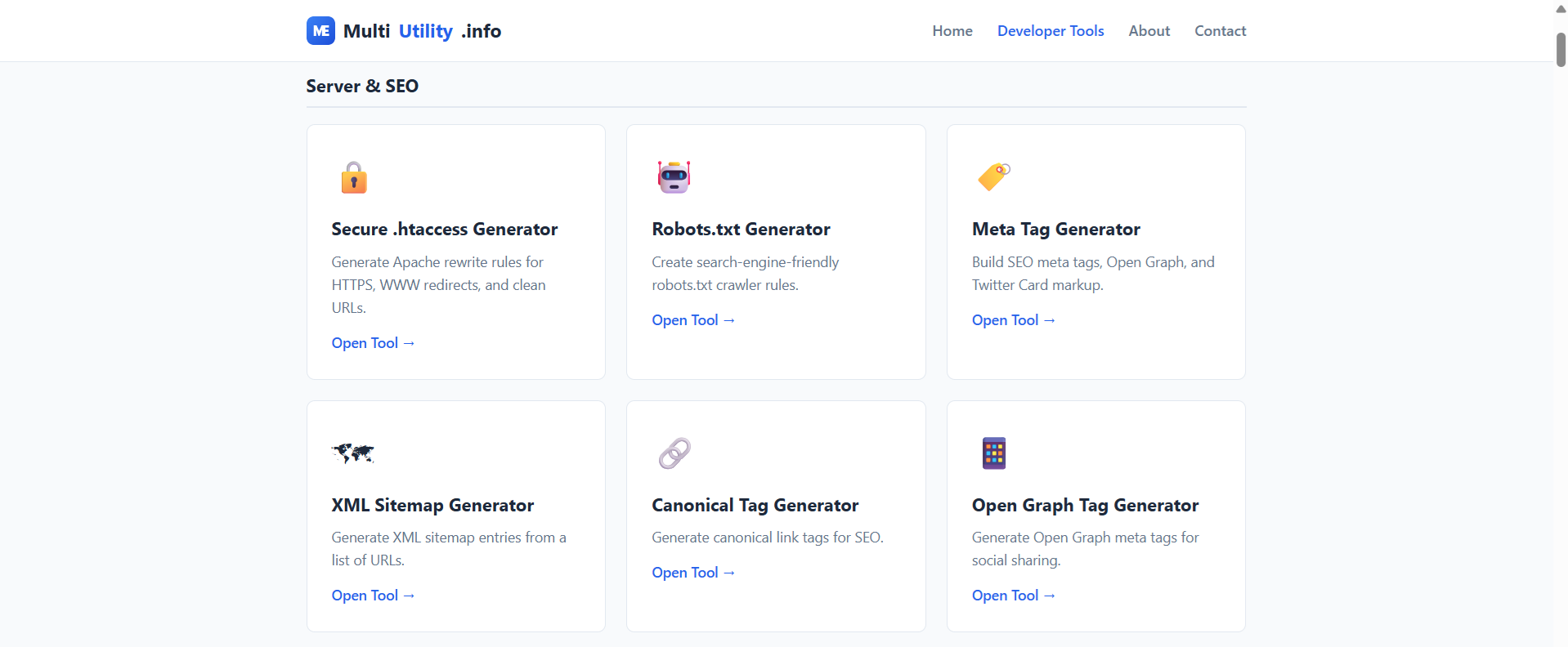
The presentation layout uses includes/tool-cards.php to parse the grouped configuration sets. When the $showCategories parameter is toggled to true, the script splits the master array into independent sub-grids segmented by category headings.
Because this HTML structure is fully computed on the server before dispatching to the client web browser, search engine spiders can instantly discover and crawl every internal link in the index, ensuring zero crawl gaps.
2.3 Instant Client-Side Search Engine
Interactive filtering is handled directly on the client side via assets/js/tools-search.js. The script implements a high-performance input tracking system that monitors user entry events:
-
Zero Latency DOM Manipulation: The script runs entirely within the visitor's browser, matching strings against the textual content of each card and toggling the target display state via
.style.display = 'none'or adding a.search-hiddenutility class. -
Contextual Category Collapsing: If an entire category grid contains zero matches for a given search query, the script automatically suppresses the parent category heading block, keeping the interface compact and intuitive.
-
Dynamic Counter Status: A live counter component dynamically updates text elements to display exact indexing parameters, such as "X of Y tools match 'query'".
3. Google AdSense & SEO Synergy Analysis
Utility websites often struggle to clear manual Google AdSense reviews due to strict automated definitions regarding "Thin Content" and "Low Value Platforms." The layout strategy executed at /developer-tools implements concrete mitigation patterns to overcome this limitation:
3.1 Content Enrichment Layer
To supplement the dynamic interactive layout, the directory injects long-form static informational text at the base of the viewport. This provides an educational overview explaining the platform's architectural privacy advantages (local browser execution using client-side JavaScript arrays). This design choice effectively satisfies programmatic value guidelines by establishing context that goes beyond basic hyperlinked navigation cards.
3.2 Metadata Optimization and Flow Compliance
-
Dynamic Variable Insertion: The parent template maps precise SEO constraints into the header context, automatically counting registry bounds to display highly descriptive summaries (e.g., "Browse X+ free online coding and developer tools...").
-
Ad Placement Safeguards: The interface reserves dedicated script areas through
includes/adsense-slot.php. The container includes defensive layout encapsulation using the.adsense-slotselector inassets/css/tools.css, which hides empty placeholder boxes until live ad scripts are verified and approved, completely avoiding empty layout layout shift blocks.
To ensure maximum performance and security as your collection of tools expands, consider deploying the following structural modifications:
-
Implement Debounce Functionality on Search Strings: The search script in
assets/js/tools-search.jsbinds directly to continuous input triggers. While lightweight across small lists, as the directory scales past 100+ items, wrapping the input listener inside a 150ms debounce window will minimize rapid re-paints of the DOM tree. -
Incorporate Explicit Lazy Loading Attributes: Ensure that visual image pathways or structural custom graphics rendered via layout fragments explicitly include
loading="lazy"tags to optimize performance for lower-bandwidth mobile clients. -
Automate Structured Site Map Re-Generation: The application includes a clean automated mapping script inside
sitemap.php. Integrate a system cron worker path to periodically ping this script, ensuring newly registered tools added to your modular arrays are automatically indexed by search engine spiders without manual file updates.